MATHEMATICS MASTERY: FROM FOUNDATIONS TO ENGINEERING READINESS - A COMPREHENSIVE GUIDE FOR 8TH TO 12TH GRADE STUDENTS
Copyright
© 2024 Benoit Tano, M.D. Ph.D. All rights reserved.
No part of this publication, titled 'MATHEMATICS MASTERY: FROM FOUNDATIONS TO ENGINEERING READINESS - A COMPREHENSIVE GUIDE FOR 8TH TO 12TH GRADE STUDENTS,' may be reproduced, distributed, or transmitted in any form or by any means, including photocopying, recording, or other electronic or mechanical methods, without the prior written permission of the publisher, except in the case of brief quotations embodied in critical reviews and certain other noncommercial uses permitted by copyright law.
This book provides a comprehensive and systematic journey into mathematical mastery, designed specifically for students between the 8th and 12th grades. Authored by the esteemed Benoit Tano, M.D. Ph.D., this educational resource bridges traditional mathematical foundations with the advanced concepts needed for engineering readiness. The content is a meticulously arranged curriculum starting with the essential 'Foundations of Mathematical Thinking,' which lays the groundwork with topics such as numerical fluency, algebra basics, geometry, and number theory, all the way through complex algebraic structures and applications.
As readers progress, 'Complex Equations and Their Applications' guide them through both theoretical understanding and practical problem-solving strategies essential for future engineers and mathematicians. Each chapter builds upon the last, ensuring that students not only understand individual concepts but also their profound connections and applications within various scientific and engineering domains.
While this guide aims to support academic advancement, it also encourages the development of critical thinking and analytical skills through the role of logic, reasoning, and interpretation of data. Whether used in classrooms or home-study environments, it stands as a robust resource for educators and learners dedicated to mathematical excellence and preparation for higher learning endeavors within the engineering field.
The author grants educators limited permission to reproduce select worksheets and assessments for face-to-face teaching within their own institutions. Any unauthorized use of the copyrighted material is strictly prohibited and constitutes a violation of international copyright laws.
For permissions beyond the scope provided above, inquiries should be directed to the publisher, ensuring all requests comply with the constraints of the intellectual property framework.
Disclaimer
The book entitled 'MATHEMATICS MASTERY: FROM FOUNDATIONS TO ENGINEERING READINESS - A COMPREHENSIVE GUIDE FOR 8TH TO 12TH GRADE STUDENTS' is authored by Benoit Tano, M.D. Ph.D., and published in the year 2024. This disclaimer serves to inform the readers about certain considerations and limitations associated with the use of the content provided within.
While this guide aims to lay a strong mathematical foundation and equip high school students with the necessary skills for future studies in engineering and related fields, it is important to recognize that this book is a supplementary educational tool and not a substitute for formal classroom instruction. The content is structured to align broadly with standard high school mathematics curricula; however, variations in educational standards and academic requirements may exist across different schools and educational institutions.
The mathematical theories, principles, and problem-solving strategies outlined in this book are presented for educational purposes and strive to provide accurate information. Nonetheless, readers are encouraged to cross-verify with additional academic resources and consult with educators to ensure comprehension and alignment with specific academic goals.
It is worth noting that while every effort has been made to ensure the accuracy and thoroughness of the content, the author and publisher cannot guarantee there are no errors or omissions. Suggestions and methodologies are offered without warranty, either expressed or implied, and should be implemented at the discretion and responsibility of the user.
Further, while the guide explores connections between mathematical concepts and engineering applications, the concepts discussed are intended for educational exploration rather than professional engineering advice or practices. Readers intending to apply these mathematical principles in professional contexts should seek expertise from qualified practitioners or professionals in the field.
Lastly, the opinions and perspectives presented in this guide represent those of the author and do not necessarily reflect official policies or positions of any affiliated educational institutions. This guide should be used as a supplementary resource to enrich the user's mathematical journey and readiness. By utilizing this book, readers acknowledge and agree to these terms and conditions.
Table of Contents
-
Foundations of Mathematical Thinking
Page --
- Introduction to Mathematical Thinking Page --
- Numerical Fluency and Patterns Page --
- Understanding Mathematical Operations Page --
- Basics of Algebra: Variables and Expressions Page --
- Introduction to Geometry: Shapes and Properties Page --
- Foundational Concepts in Number Theory Page --
- The Role of Logic and Reasoning in Mathematics Page --
- Interpreting and Analyzing Data Page --
- Developing Problem-Solving Strategies Page --
-
Complex Equations and Their Applications
Page --
- Introduction to Complex Numbers Page --
- Quadratic Equations: Solutions and Real-World Applications Page --
- Systems of Equations: Linear and Nonlinear Page --
- Understanding Polynomials and Their Properties Page --
- Exponential and Logarithmic Equations Page --
- Trigonometric Equations and Identities Page --
- The Role of Complex Numbers in Advanced Engineering Page --
- Inequalities and Their Applications Page --
- Solving Real-World Problems Using Complex Equations Page --
Preface
In the vast and intricate tapestry of human knowledge, mathematics stands out as both a timeless constant and a dynamic, ever-evolving field. It is the language in which the universe has been written, a universal dialect that transcends cultural and temporal boundaries, linking the arcane with the mundane. Within its intricate structures lies the foundation upon which modern engineering and technology are built, propelling us into the new and the extraordinary. 'MATHEMATICS MASTERY: FROM FOUNDATIONS TO ENGINEERING READINESS' by Benoit Tano, M.D. Ph.D, offers an ambitious journey for students from grades 8 to 12, transforming the abstract into the tangible and unlocking the hidden potential each student harbors for mastering this discipline.
As students embark on this journey, they will first encounter the 'Foundations of Mathematical Thinking', a chapter designed to cultivate an intuitive grasp of mathematical concepts. Here, they will wander through the hallways of numerical fluency, engage with the elegance of algebraic expressions, and discover the geometric beauty inherent in shapes and forms. These preliminary chapters are crafted to strengthen one's mathematical muscles, focusing on essential skills that serve as the bedrock of more complex computations encountered in later sections. Logical reasoning and data interpretation are highlighted, encouraging learners to develop problem-solving strategies crucial for academic success and real-world applications.
Progressing into 'Complex Equations and Their Applications', students will be invited to explore the depths of intricate mathematical theories. From solving quadratic and trigonometric equations to unraveling the mysteries of complex numbers, this chapter guides students through the complexities and wonders of higher-level mathematics. The notion of mathematics as a practical tool is emphasized through real-world problem-solving scenarios, demonstrating the power of equations in engineering and beyond.
Ultimately, this guide is not merely a textbook; it is a transformative experience, urging students to dissolve barriers and surpass traditional limits. It nurtures a growth mindset, enabling students to see mathematics not as an academic chore but as an empowering tool, unlocking doors to countless future possibilities. As we dive into this comprehensive exploration, we are reminded that mathematics is not just a subject but a stepping stone to innovation, creativity, and boundless ingenuity.
Foreword
In a world where technology and innovation are rapidly reshaping landscapes, the role of mathematics as a foundational pillar cannot be emphasized enough. Mathematics is not just numbers and equations—it is a universal language that unveils the intricacies of the universe, fuels scientific breakthroughs, and is crucial for the development of engineering solutions that power our modern world.
Benoit Tano, M.D., Ph.D., presents 'Mathematics Mastery: From Foundations to Engineering Readiness - A Comprehensive Guide for 8th to 12th Grade Students' at a time when the need for robust mathematical education is paramount. Armed with a profound understanding of mathematical principles and a dedication to teaching, Dr. Tano lays out a clear, engaging path for young learners who aspire to harness the power of mathematics in academic pursuits and engineering careers.
This book is thoughtfully structured, beginning with 'Foundations of Mathematical Thinking,' which establishes the core principles that are integral to the student’s journey through mathematics. It delves into numerical fluency, patterns, basic algebra, and foundational geometry, gradually building up to more complex ideas like logic, reasoning, and advanced problem-solving techniques.
In 'Complex Equations and Their Applications,' learners are introduced to significant concepts such as complex numbers, quadratic and polynomial equations, and critical engineering calculations, which are indispensable tools in advanced mathematics and engineering fields. Dr. Tano presents these complex topics with clarity, making them accessible to students, fostering not just understanding but also a genuine interest in how these mathematical principles can be applied to solve real-world problems.
With this comprehensive guide, Dr. Tano not only prepares students for the rigors of high school mathematics but also ignites a passion for learning and discovery. Whether the reader aims for a career in engineering, technology, or any field that hinges on mathematical expertise, this book is a companion in developing the critical thinking and problem-solving abilities necessary to excel.
Thus, 'Mathematics Mastery' is more than a mere textbook; it is an invitation to embrace the beauty of mathematics as a tool for innovation and growth. It paves the way for the next generation of engineers, thinkers, and global leaders to confidently stride into a future directed by informed curiosity and analytical prowess.
Foundations of Mathematical Thinking
Introduction to Mathematical Thinking
Embarking on the journey of mathematical thinking is akin to learning a new language. It entails not only understanding numbers and symbols but also grasping the patterns and logic that weave them into coherent stories of quantity and shape.
\(2x + 3 = 7\)
At the heart of this cognitive transformation is the ability to see beyond individual equations into the interconnectedness of mathematical concepts. This process of abstraction allows one to transition from solving simple arithmetic problems to deciphering intricate algebraic expressions.
\[\frac{a+b}{c} = d\]
Furthermore, the development of a mathematically inclined mind requires cultivating a sense of curiosity and skepticism. By questioning assumptions and exploring alternative methods, students can discover innovative solutions that enhance their analytical prowess and pave the way for advanced mathematical triumphs.
Numerical Fluency and Patterns
Numerical fluency is the cornerstone of mathematical confidence, akin to mastering vocabulary when learning a new language. It involves a deep understanding of numbers, their properties, and how they interact within different mathematical contexts. This fluency extends beyond mere computation; it includes recognizing patterns and relationships that give structure to abstract mathematical ideas.
\(2 + 2 = 4\)
By recognizing fundamental patterns, such as arithmetic sequences or geometric progressions, students enhance their predictive capabilities, critical for both basic arithmetic and complex problem solving. Such patterns help in discerning the progression of numbers, offering insights into their inherent regularities.
\[\text{Total Cost} = \text{Base Cost} + n \cdot \text{Cost Per Unit}\]
Mastery of numerical patterns empowers students to venture beyond rote learning into creative problem solving, equipping them with the critical skills needed for advanced mathematics and engineering applications. This ability to see connections across different mathematical domains fosters an adaptable and innovative mindset, crucial in an ever-evolving world.
Understanding Mathematical Operations
Mathematical operations serve as the keystone of problem-solving, providing the structural foundation that integrates various mathematical concepts. Embarking on this facet of mathematics involves mastering the fundamental operations: addition, subtraction, multiplication, and division. These operations transform abstract ideas into tangible solutions, enabling learners to navigate the mathematical landscape with confidence.
\(a + b = c\)
Understanding these operations goes beyond mechanical computation. It's about perceiving the inherent logic that guides their application across diverse scenarios. For example, multiplication is not merely repeated addition, but a tool for scaling and for predicting outcomes in complex situations. This nuanced understanding elevates operations from ritualized steps to strategic tools.
\[\frac{x}{y} = z\]
Through targeted practice and exploration, students learn to manipulate these operations with agility, opening new avenues for exploration in mathematical theories. Such proficiency nurtures an analytical mindset, encouraging deeper engagement with equations and fostering readiness for advanced applications in engineering and science.
Basics of Algebra: Variables and Expressions
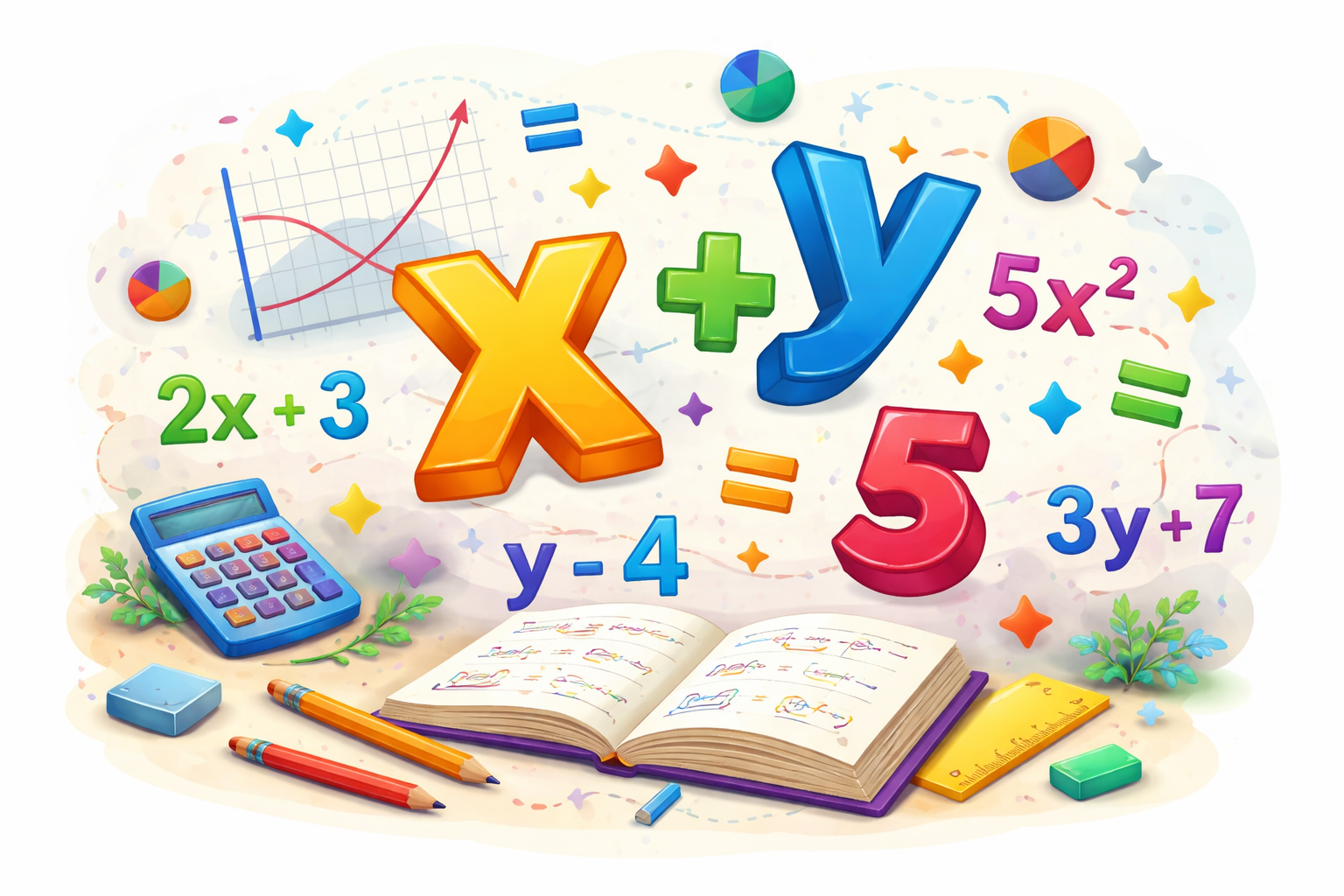
Diving into the realm of algebra unveils a world where numbers are no longer the sole players. Variables, often represented by symbols like x and y, embody unknown values or quantities that we seek to unravel.
\(x + 5 = 12\)
Expressions, akin to mathematical phrases, combine variables with constants through operations. Mastering these elements requires an appreciation for their flexibility in representing real-world phenomena and abstract mathematical ideas alike.
\[3y - 2 = 10\]
By manipulating variables and expressions, students learn to form and solve equations—critical tools for mathematical reasoning. This hands-on practice emboldens learners to explore the rich tapestry of algebraic structures, paving the path to more complex mathematical challenges.
Introduction to Geometry: Shapes and Properties
Geometry, the branch of mathematics that explores shapes, dimensions, and their properties, invites students into an ancient discipline where abstraction meets visual intuition. From simple lines and angles to complex structures, geometry offers a unique blend of analytical and creative thinking.
\(A = \pi r^2\)
Understanding shapes, such as circles, triangles, and polygons, involves grasping their intrinsic properties—a process that aids spatial reasoning and aids in solving practical problems. For instance, knowing the relationship between the sides of a triangle—
\[a^2 + b^2 = c^2\]
—empowers students to calculate distances and areas with precision. As we delve into geometric principles, theorems like Pythagorean or properties of angles in parallel lines emerge, enriching problem-solving skills. Geometry forms the foundation for engineering, architecture, and art, allowing the transformation of conceptual ideas into tangible creations.
Foundational Concepts in Number Theory
Number theory serves as the bedrock of mathematical curiosity, diving into properties and relationships between numbers. This intriguing field explores prime numbers, which are the building blocks for all integers, offering a glimpse into the universe’s intricate numerical patterns.
\(2^3 = 8\)
Exploring the realm of divisors and multiples, students unearth secrets of divisibility rules and greatest common divisors—concepts vital to simplifying fractions and solving modular arithmetic problems. Such explorations deepen understanding and develop abstract thinking abilities.
\[n = pq\]
Fibonacci sequences and Lucas numbers introduce sequences whose unique properties connect to nature's growth patterns, revealing the harmony between mathematics and the world. Investigating these patterns equips students with insights for engineering and scientific applications as they discover how structure and chaos coexist within the mathematical world.
The Role of Logic and Reasoning in Mathematics
Logic and reasoning form the backbone of mathematical rigor, offering the tools needed to validate concepts and solve complex problems. By embracing logical structures, students decode mathematical statements and construct meaningful arguments. This path leads to profound understanding, moving beyond computation to explore the ‘why’ of mathematics.
if p and q, then r
The art of proof is central to this endeavor, teaching learners to construct and deconstruct assertions systematically. Whether through direct proof, contradiction, or induction, reasoning builds a bridge between intuition and formal mathematical thought. This engagement nurtures critical thinking, empowering students to discern the truth.
\[\forall x (P(x) \Rightarrow Q(x))\]
In everyday scenarios, logical reasoning unveils solutions hidden within numerical patterns and algebraic expressions. The journey through this realm prepares students for real-world challenges, where decision-making hinges on coherent, logical thought. Mastery of reasoning sets the foundation for advanced studies and engineering feats.
Interpreting and Analyzing Data
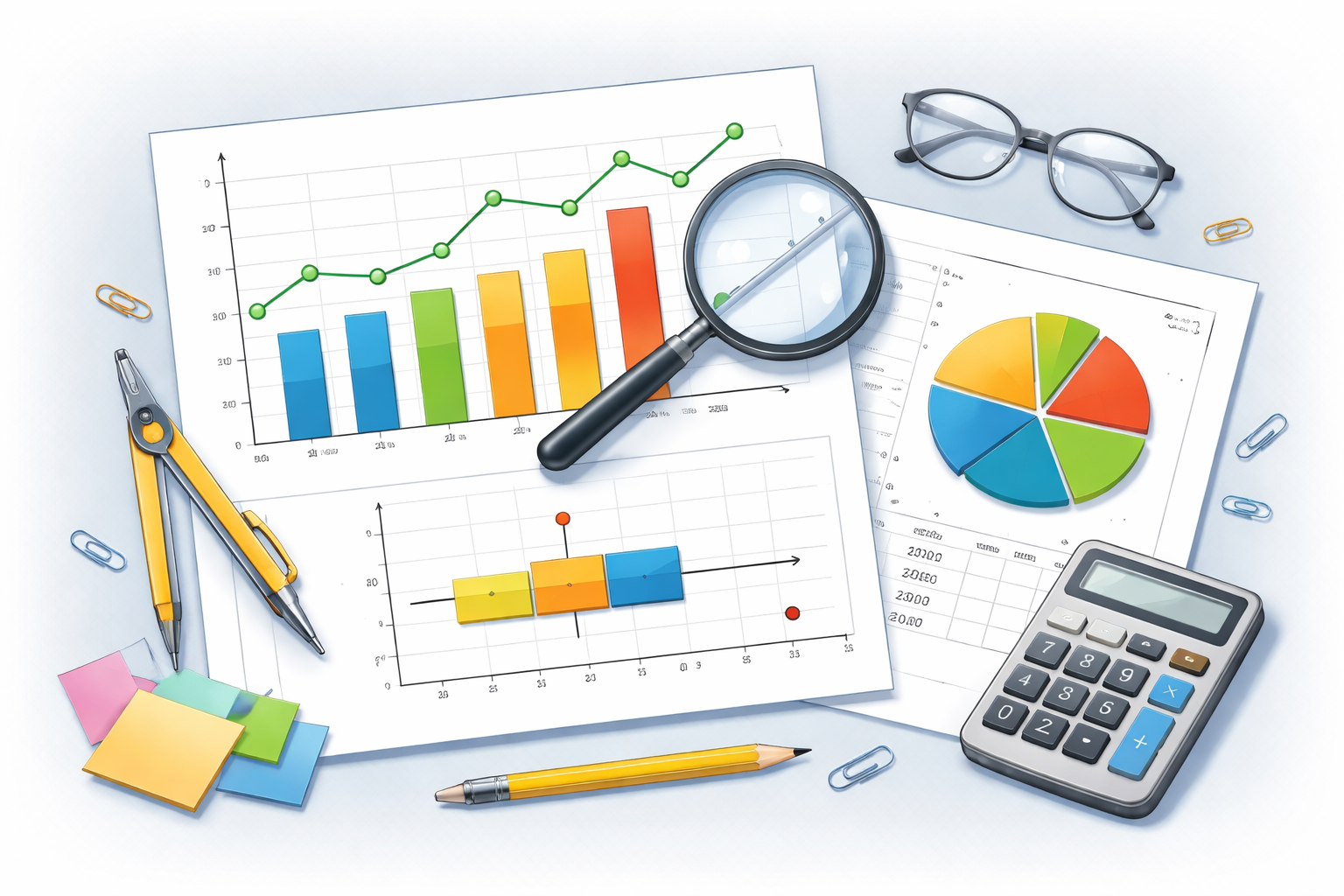
Understanding data is crucial in today's information-rich world. It empowers students to transform numbers into meaningful insights. Interpreting data involves the skillful extraction of patterns and trends, enabling informed decision-making.
\(E(X) = \sum_{i=1}^{n} x_i p(x_i)\)
Analyzing data requires a methodical approach. Students learn to employ statistical tools, such as mean, median, and mode, to describe datasets succinctly. Visualization through graphs and charts provides clarity, allowing patterns to emerge vividly.
\[\sigma = \sqrt{\frac{1}{N} \sum_{i=1}^{N} (x_i - \mu)^2}\]
As students refine their analytical skills, they develop a critical mindset essential for identifying anomalies and correlations. This foundation not only prepares them for advanced studies in engineering but also cultivates a lifelong appreciation for data-driven exploration.
Developing Problem-Solving Strategies
The art of problem-solving transcends mere memorization, embedding deep analytical skills and critical thinking into a student's cognitive toolkit. Developing strategies involves breaking down complex problems into manageable parts, akin to untangling a complex web into distinct strands.
S is the set of all x where f of x equals zero
One foundational approach is identifying patterns and relationships, which creates pathways to uncover solutions. By recognizing how different elements interact within mathematical constructs, students begin to appreciate the elegance of symmetry and proportionality. For example, exploring how changing one variable in an equation can cascade through others instills a greater comprehension of interdependencies.
\[\frac{d}{dx}(x^2 + y^2) = 2x + 2y \cdot \frac{dy}{dx}\]
Collaboration and discussion also form an integral part, allowing different perspectives to inform the resolution process. Sharing ideas leads to innovative solutions, fostering an environment where questions drive exploration rather than rote answers. Thus, problem-solving strategies become a bridge from foundational knowledge to complex engineering challenges.
Complex Equations and Their Applications
Introduction to Complex Numbers
Complex numbers, denoted as the fusion of real and imaginary parts, delightfully extend our mathematical horizon beyond the real number line. Born from the necessity to solve equations like quadratic equations without real solutions, they introduce a new realm of possibilities.
\(a + bi\)
The notation 'i', representing the square root of negative one, unlocks the door to this intriguing domain. Imaginary numbers, once considered abstract curiosities, are pivotal in fields like engineering and physics. The geometric representation of complex numbers on the complex plane underscores their elegance and utility.
\[i^2 = -1\]
Engaging with complex numbers enriches our problem-solving toolkit, allowing transformations that simplify seemingly intractable problems. As students delve deeper, they uncover the symmetries and patterns that render complex numbers indispensable in advanced mathematics and engineering.
Quadratic Equations: Solutions and Real-World Applications
Quadratic equations, fundamental in algebra, are polynomials of degree two that take the form \(ax^2 + bx + c = 0\). These equations not only offer mathematical challenges but also manifest in various real-world scenarios.
\(ax^2 + bx + c = 0\)
The quadratic formula, \(x = \frac{-b \pm \sqrt{b^2 - 4ac}}{2a}\), provides solutions by unraveling the mystery of the roots. Whether determining projectile paths in physics or optimizing areas in engineering, their ubiquitous nature is evident.
\[x = \frac{-b \pm \sqrt{b^2 - 4ac}}{2a}\]
Graphically, quadratics form parabolas, the essence of vertical motion under gravity. Architectural designs often utilize parabolic arches due to their aesthetic and load-bearing advantages. Mastery of quadratics, thus, equips students with versatile problem-solving tools, bridging foundational math and practical applications.
Systems of Equations: Linear and Nonlinear
Systems of equations, where multiple equations are solved in tandem, form a cornerstone of both theoretical and applied mathematics. They encapsulate the essence of problem-solving by illustrating how different mathematical entities intersect with each other.
\(ax + by = c\)
Linear systems are straightforward, each equation represents a line in two dimensions. The solution lies at the intersection point of these lines, offering insights into consistency and dependency of variables. By extending to three dimensions, we perceive the intersection of planes.
\[\begin{align*} x + y + z &= 6 \\ 2x - y + 2z &= 3 \end{align*}\]
Nonlinear systems, however, introduce complexity by incorporating curves and surfaces. These systems demand nuanced techniques like substitution and graphing. Solving them not only sharpens analytical skills but also fosters a deeper understanding of diverse mathematical landscapes.
Understanding Polynomials and Their Properties
Polynomials are the mathematical expressions that consist of variables and coefficients, linked together by operations of addition, subtraction, and non-negative integer exponents. Their structure is both simple and profound, serving as a cornerstone in algebra and calculus.
\(ax^n + bx^{n-1} + \cdots + cx + d\)
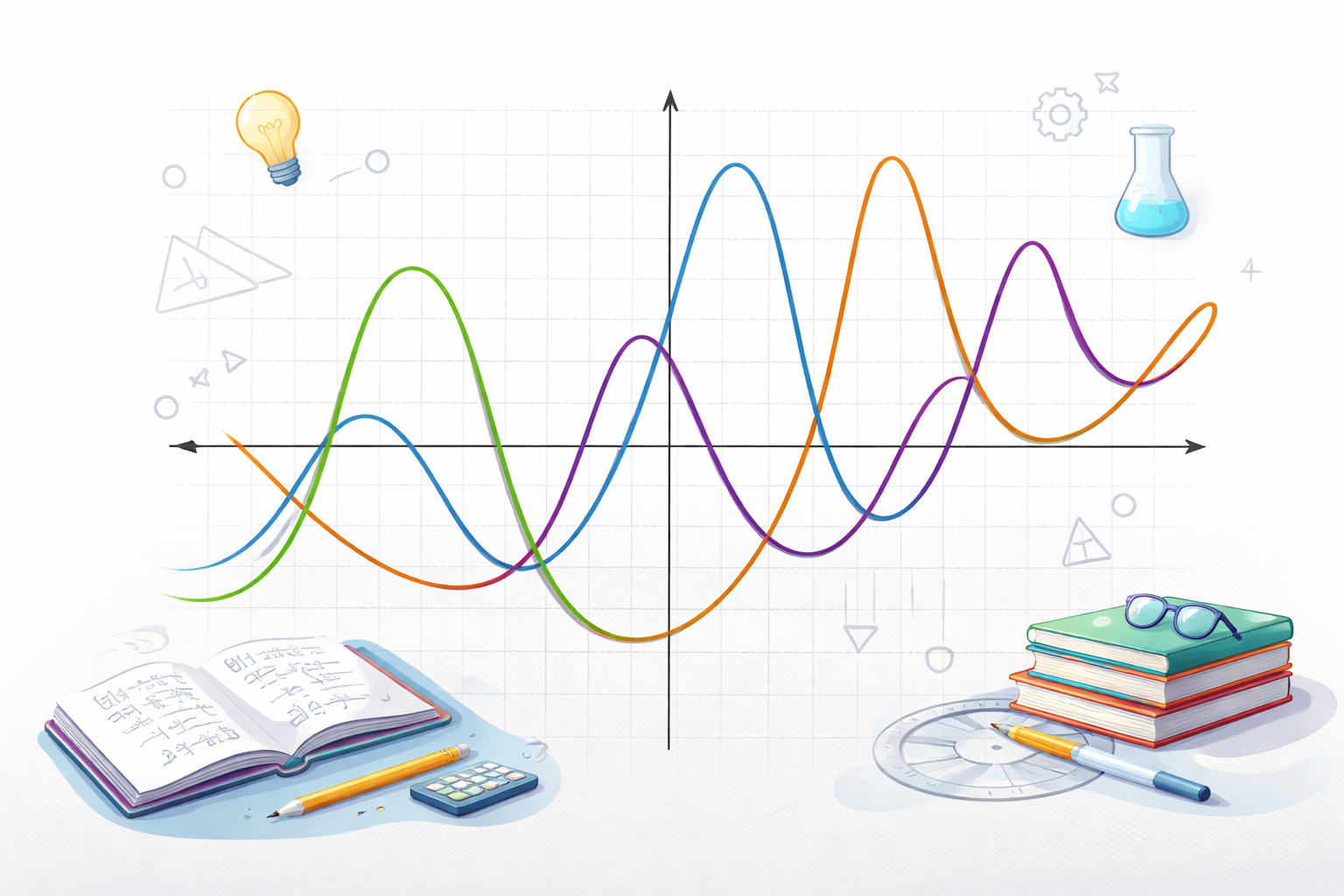
Each polynomial can be classified by its degree, represented by the highest exponent of its variable. This degree dictates the polynomial's behavior and graph's curvature, revealing crucial properties such as roots, extrema, and inflection points.
\[f(x) = x^3 + 2x^2 - x - 2\]
Polynomials find extensive application in engineering, modeling curves and surfaces with precision. Understanding the intricacies of polynomial division, theorems, and long-term behavior aids in constructing solutions to complex real-world challenges. Mastery of polynomials equips students with essential tools for higher mathematical learning.
| Characteristic | Description |
|---|---|
| Degree | Highest exponent of the variable |
| Roots | Solutions where the polynomial equals zero |
| Symmetry | Reflection properties of the graph |
| End Behavior | Tendencies of the graph as x approaches infinity |
Exponential and Logarithmic Equations
Exponential and logarithmic equations are vital tools in the realm of mathematics, underpinning many scientific and engineering principles. At their core, these equations reveal the intriguing dance between growth and decay, forming the backbone of topics ranging from compound interest to population dynamics.
\(y = a \cdot b^x\)
An exponential equation, characterized by its rapidly increasing or decreasing values, is often expressed in the form y = a \(\cdot\) b^x, where a and b are constants. This model describes phenomena such as radioactive decay and investment growth. Conversely, logarithmic equations serve as the inverse, unraveling the exponential puzzle.
\[x = \log_b(y)\]
Logarithmic scales simplify the management of large quantities by linearizing exponential growth, crucial for understanding sound intensity and earthquake magnitudes. Mastery of these equations allows students to unveil and predict patterns in complex systems, bridging fundamental mathematics and real-world engineering applications.
-
Quadratic Equations: Solutions and Real-World ApplicationsQuadratic equations, fundamental in algebra, are polynomials of degree two that take the form \(ax^2 + bx + c = 0\).
-
Systems of Equations: Linear and NonlinearSystems of equations, where multiple equations are solved in tandem, form a cornerstone of both theoretical and applied mathematics.
-
Understanding Polynomials and Their PropertiesPolynomials are the mathematical expressions that consist of variables and coefficients, linked together by operations of addition, subtraction, and n…
-
Exponential and Logarithmic EquationsExponential and logarithmic equations are vital tools in the realm of mathematics, underpinning many scientific and engineering principles.
-
Trigonometric Equations and IdentitiesTrigonometric equations and identities form the bedrock of understanding periodic phenomena, from mechanical vibrations to electromagnetic waves.
-
The Role of Complex Numbers in Advanced EngineeringIn advanced engineering, complex numbers play a crucial role in handling problems that involve two-dimensional vectors and oscillations.
Trigonometric Equations and Identities
Trigonometric equations and identities form the bedrock of understanding periodic phenomena, from mechanical vibrations to electromagnetic waves. Discovering these relationships is like unlocking the mathematical rhythm that governs various physical processes.
\(sin^2\theta + cos^2\theta = 1\)
Central to trigonometric studies are the identities, those elegant, time-honored expressions that relate angle measures to their sine and cosine counterparts. Consider the Pythagorean identity, which not only clarifies the inherent symmetry but also unveils deeper insights.
\[\tan\theta = \frac{\sin\theta}{\cos\theta}\]
Furthermore, trigonometric equations enable precise problem-solving strategies in engineering, whether optimizing sound waves or analyzing architectural angles. Mastery of these equations provides students with the analytical prowess to model and predict oscillatory behavior, vital for dynamic systems.
By delving deeper into these equations, one can appreciate the harmony and periodicity underscoring the universe's grand design. The intricate dance of angles and ratios reveals the beauty of mathematics applied to the tangible world.
The Role of Complex Numbers in Advanced Engineering
In advanced engineering, complex numbers play a crucial role in handling problems that involve two-dimensional vectors and oscillations. These numbers, expressed in the form of a + bi, allow engineers to model and solve intricate equations efficiently.
\(a + bi\)
Electronics heavily utilize complex numbers to analyze alternating currents, where sinusoidal waves are simplified using complex exponentials. Here, engineers employ Euler's formula, connecting exponential functions and trigonometric functions.
\[e^{ix} = \cos x + i\sin x\]
Mechanical systems also benefit from complex numbers for vibrations and wave motion solutions. Applying the concept of phasors, engineers represent oscillatory systems succinctly, thus simplifying computations and interpretations. In essence, mastering complex numbers equips students with indispensable tools, fostering innovation and analysis within diverse engineering fields.
Inequalities and Their Applications
Inequalities are versatile tools in mathematics, revealing relationships between expressions that extend beyond mere equality. They provide insight into ranges, constraints, and optimal solutions within diverse scenarios. Understanding inequalities equips students with the ability to tackle real-world problems, offering more than just a binary perspective.
\(a > b\)
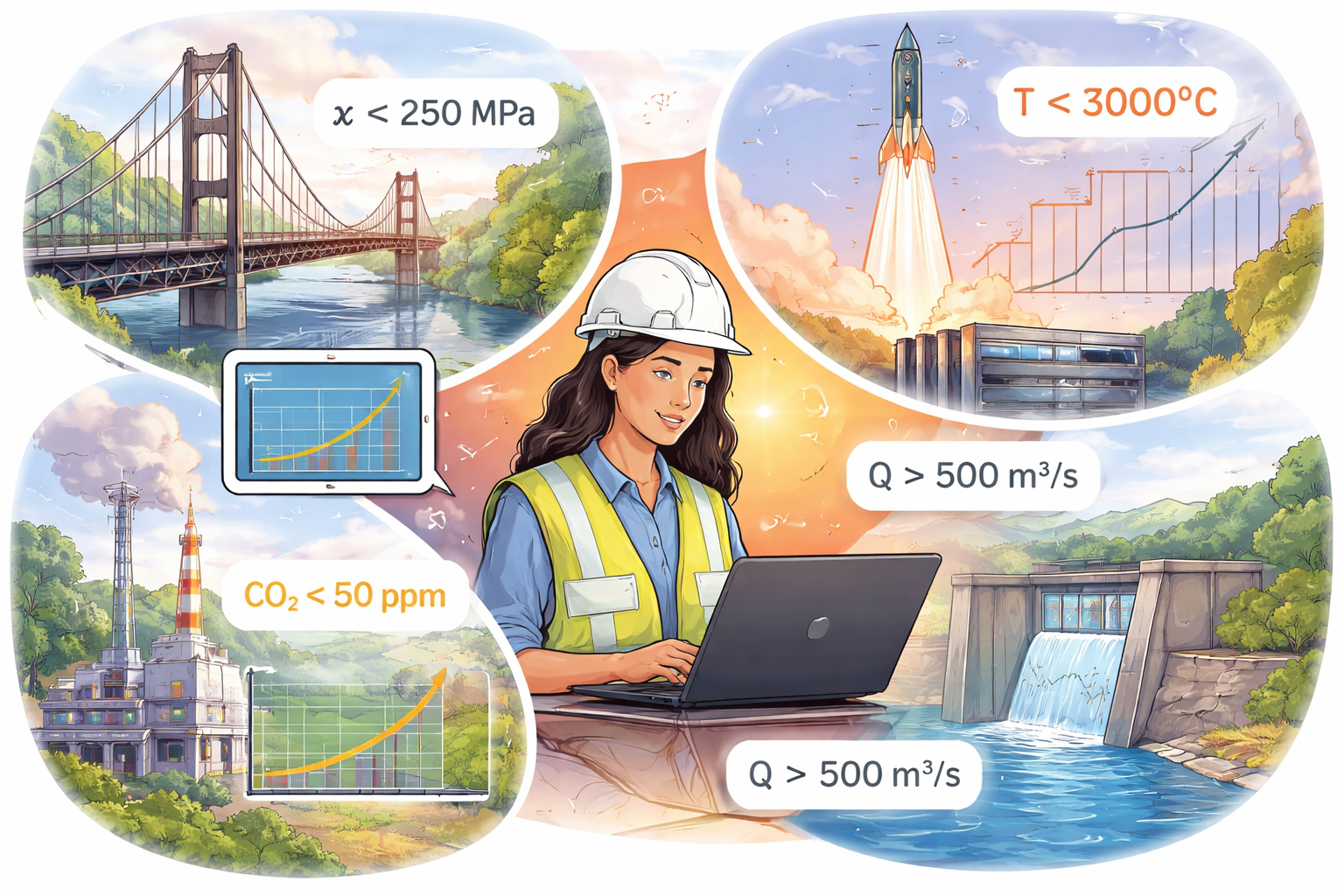
In engineering and science, inequalities play a pivotal role in defining limits and boundaries. For instance, ensuring material strength within safe limits or optimizing resources in complex systems often relies on these foundational concepts. This allows engineers to make precise, informed decisions in design and analysis.
\[\frac{x}{y} \leq 1\]
Through mastering inequalities, students can develop robust problem-solving strategies. From maximizing profit to minimizing cost, the applications are vast. By embracing the nuances of greater than, less than, and equal to, students can navigate the intricate landscapes of mathematics and its practical applications with confidence.
Values are calculated from generated section word counts.
Solving Real-World Problems Using Complex Equations
Complex equations serve as a bridge between abstract mathematics and tangible real-world challenges. In engineering and physics, these equations often describe scenarios where multiple variables interact intricately. Complex numbers, denoted as a plus bi, are pivotal for modeling waveforms and electrical currents.
\(a + bi\)
Consider the analysis of harmonic oscillators, where the position of a particle is influenced by forces that follow a predictable, rhythmic pattern. Here, complex equations are used to model the oscillatory behavior, allowing engineers to devise systems resilient to environmental changes and stresses.
\[e^{ix} = \cos{x} + i\sin{x}\]
Moreover, in telecommunications, complex equations are fundamental in signal processing, ensuring data integrity across vast networks. By implementing these mathematical frameworks, it's possible to optimize bandwidth and enhance transmission quality, reflecting their pivotal role in modern technology.
\[\omega = \frac{d\theta}{dt}\]
Students mastering these equations gain a robust toolkit for solving multifaceted challenges, melding theoretical knowledge with practical applications.
Epilogue
As we conclude this comprehensive guide, 'Mathematics Mastery: From Foundations to Engineering Readiness', it is my hope that you, the reader, have embarked on a transformative journey through the wonders of mathematics. Whether you are an eighth-grade student taking your first steps into the world of algebra and geometry, or a twelfth grader on the cusp of academic and professional horizons in engineering, this text aims to be more than just a resource; it strives to be an inspiration.
Mathematics, a language of precision and beauty, underpins the very fabric of the sciences and engineering. Each chapter laid the groundwork for a deeper understanding, starting with foundational mathematical concepts and gradually advancing toward complex equations and their significant applications. Through the explorations of numerical fluency, equations, logic, geometrical shapes, and data interpretation, I aimed to not only educate but also ignite a curiosity-driven approach to learning.
This book has endeavored to forge a connection between theoretical mathematics and real-world challenges. Engaging with quadratic equations has been tied directly to tangible applications, and the exploration of inequalities, polynomial functions, and trigonometric identities were designed to stir imaginations about the infinite possibilities awaiting in the realms of engineering and technology.
Each topic was chosen not just for its academic value, but for its potential to form the basis of innovative problem solving in our dynamic world. Mathematics is a tool, a craft that hones the precision, creativity, and critical thinking skills necessary for future technological advances. Such mastery equips you with the tools to face, adapt, and solve complex issues that stand between our current understanding and the breakthroughs of tomorrow.
In closing, remember that every equation, every problem, and every proof serve as stepping stones to your intellectual evolution. Grasp each concept with determination and curiosity, and carry forward the spirit of inquiry beyond these pages. Mathematics does not end with solving problems—it begins there, inspiring endless possibilities in your journey towards readiness for a career in engineering or any path that mathematics illuminates.
MATHEMATICS MASTERY: FROM FOUNDATIONS TO ENGINEERING READINESS - A COMPREHENSIVE GUIDE FOR 8TH TO 12TH GRADE STUDENTS
Unlock the secrets of mathematics with 'MATHEMATICS MASTERY: FROM FOUNDATIONS TO ENGINEERING READINESS.' Crafted meticulously by Benoit Tano, M.D. Ph.D., this comprehensive guide is designed for ambitious students from 8th to 12th grade, setting them on the path to engineering excellence. Dive into the fundamental principles of mathematical thinking and explore the intriguing world of numbers, shapes, and equations. From the building blocks of algebra and geometry to the complexities of logarithmic and trigonometric equations, every chapter is a stepping stone toward mastery. Understand the pivotal role of logic, problem-solving, and analytical data interpretation. This book not only covers academic essentials but also empowers students with the skills needed to tackle real-world engineering problems. With a focus on bridging foundational concepts to advanced applications, Benoit Tano transforms learning mathematics into an engaging and rewarding adventure. Elevate your mathematical understanding and prepare for the engineering challenges ahead. This is the ultimate companion for young mathematicians poised to change the world.